Learn
Harrogate developed as a spa town around an unusually rich and dispersed field of mineral springs. Rather than forming around a single spring or bathing complex, the town grew from several centres associated with different mineral waters, including the early settlements of High Harrogate and Low Harrogate.
The waters influenced the development of buildings, routes and open spaces across the town. The creation of the Stray in 1778 protected public access to the springs while establishing a broad area of open land that shaped Harrogate’s subsequent growth. At Low Harrogate, a more concentrated spa ensemble developed around the principal sulphur wells, bringing together the Pump Room, baths, civic and cultural buildings, gardens and spaces for public life.
From this urban concentration, the spa landscape extends through Bogs Field and Valley Gardens towards Pinewoods and the wider landscape beyond. Together, these elements explain the distinctive spatial form of Harrogate as a spa town.


Geology and Waters
Harrogate’s development as a spa town begins beneath the surface. Its mineral springs are associated with a complex geological structure of folded and faulted Carboniferous rocks, particularly the Harrogate Anticline and the fault systems that run through and around the town.
Groundwater moving through these different rock formations dissolves minerals before returning to the surface. The result is an unusually varied group of mineral waters, including sulphur and iron-rich chalybeate springs, occurring across a relatively compact area.
More than 80 mineral wells and springs have been identified historically across Harrogate. They do not represent a single source emerging at different points, but a dispersed field of waters with differing compositions and characteristics.
This distribution is fundamental to understanding the town. Harrogate did not develop around one thermal spring or a single bathing establishment. Different waters were discovered and used at different locations, creating several early centres of spa activity and shaping the landscape and settlement pattern that subsequently developed around them.
The geology therefore underpins more than Harrogate’s spa history and is the starting point for understanding its urban form.
Formation
Harrogate developed from two distinct settlements, High Harrogate and Low Harrogate, each associated with different groups of mineral springs. High Harrogate grew around the earliest known wells, including Tewit Well and St John’s Well, while Low Harrogate developed around the stronger sulphur waters that would become central to the later spa resort.
As the reputation of the waters grew, lodging houses, inns, bathing facilities and other services developed around these separate centres. For much of Harrogate’s early history, they remained physically distinct, with open land between them.
The creation of the Stray in 1778 was a decisive moment in the town’s development. Two hundred acres of common land were protected around and between the principal springs, securing public access to the waters while establishing a broad area of open ground that would constrain and shape later development.
During the nineteenth century, the spa expanded rapidly. New streets, hotels, villas, public buildings and transport connections gradually joined High and Low Harrogate into a larger resort town, while the protected open landscape remained embedded within its urban form.
Harrogate therefore developed not from a single centre, but through the gradual joining of several spa landscapes and settlements around a shared system of mineral waters.

Spa Landscape
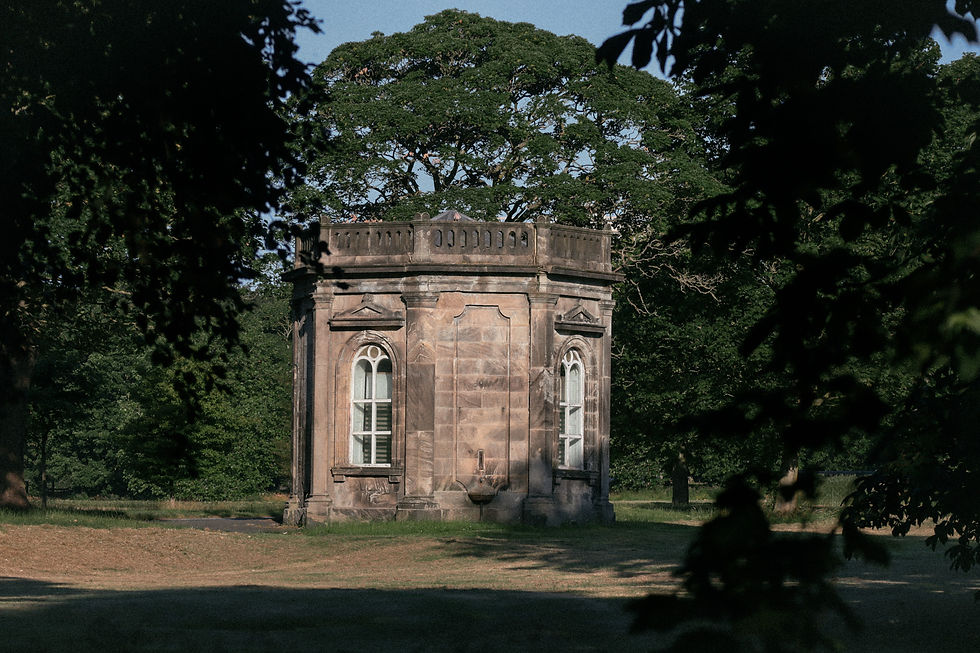
Harrogate’s spa landscape developed as a connected system of springs, open land, buildings, gardens and routes rather than as a single spa complex.
The Stray is fundamental to this structure. Established by the Award of 1778, its 200 acres protected access to the mineral springs and preserved a broad horseshoe of open land linking High and Low Harrogate. As the town expanded around it, the Stray became one of the principal organising elements of Harrogate’s urban form.
At Low Harrogate, a more concentrated spa ensemble developed around the sulphur springs. The Royal Pump Room, Royal Baths, Royal Hall or Kursaal, Crescent Gardens, former Promenade Rooms, municipal buildings and surrounding streets form the principal concentration of buildings and public spaces associated with the town’s spa, community and social life.
Immediately beyond this ensemble lies Bogs Field, now forming the eastern part of Valley Gardens. Historically part of the protected Stray, Bogs Field contained thirty-six recorded mineral springs. Its gradual development into public gardens connected the principal spa buildings with a landscape designed for access to the waters, walking and recreation.
Valley Gardens continues westwards, becoming progressively less urban before meeting Pinewoods or Kurwald and the wider landscape beyond. This relationship between the spa buildings, gardens, promenades and woodland reflects a wider characteristic of European spa towns, where exercise and time spent in the landscape formed part of taking the cure.
Together, the Stray, Spa Ensemble, Valley Gardens and Pinewoods form distinct but connected parts of Harrogate’s wider spa landscape.
European Context
Harrogate belongs to the great European tradition of spa towns that developed around mineral waters as places of health, culture, landscape and sociability. Across Europe, these towns evolved distinctive forms in which springs, baths, pump rooms, hotels, cultural buildings, promenades, gardens and surrounding landscapes worked together as part of the cure.
Harrogate is a particularly complete expression of this tradition. Its spa character is not confined to a single building or quarter, but is embedded across the structure of the town. An exceptional concentration and variety of mineral springs underlies its development; the Stray preserves a major protected spa landscape at the heart of the town; the principal Spa Ensemble brings together its most important spa, civic and cultural buildings; and Valley Gardens and Pinewoods extend this structure into gardens, promenades and woodland.
This combination gives Harrogate a distinctive form among European spa towns. The dispersed mineral waters of High and Low Harrogate, the extraordinary scale of the protected Stray and the close relationship between the built resort and its therapeutic landscape produced a spa town that operates at the scale of the whole place.
The Great Spa Towns of Europe World Heritage Site brings together eleven internationally significant spa towns and establishes a wider framework for understanding this shared European phenomenon. Harrogate forms part of that same cultural and spatial tradition, with its own distinctive contribution: a spa town shaped by an unusually rich field of mineral waters, a protected landscape of exceptional scale, and a remarkably complete relationship between water, town and landscape.
